Skip to content

Category: The Power Of Reflection

Let It Linger

As an extension off yesterday’s post, not only do I think it’s better to read several pages from one author versus one page from several different authors (emails and blogs included)… I also think it’s better to read one page from one author and really think about what it said (and do inner work with what thoughts it evoked) versus reading a bunch of pages from one author filled with bunches and bunches of what they think with no time to think about any of it.

Inbox zero is tempting. Getting the book checked off your list is appealing. Sucking up every idea and insight available to you in every moment of every day can feel deceptively productive.

But the reality is, as I was alluding to yesterday, tons of insight plus zero processing space pushes those insights out of your brain just as fast as they’re getting sucked in—because our short term memories can only store so much… which is why we (I) can spend an hour watching short videos, feel good about them while I’m doing it, and finish feeling like I took nothing away.

The key takeaway from this is that insight isn’t instantly integrated. Insight needs processing space—inner work time—where it can simmer, settle, and melt into your being.

Otherwise, it’s in one ear and out the other… in one eye and out the other… in one side of your brain and forced out the other… letting it linger is what allows it to stay within. And lingering happens only when there’s nothing else pushing it around and out of the way.
Answering Tough Questions

Today I completed a questionnaire to help a fellow martial artist with a research project which explores the correlation between tournament participation and personal growth in martial arts.

It took me about an hour to complete and let me tell you… it challenged me mentally in the same way a one-hour sparring match would’ve challenged me physically. Answering these questions was tough—like many things in martial arts—which is precisely why we do them.

…Because on the other side of tough things… is a tough(er) self.

Here are some of the questions I fought over:

  • What has been your biggest challenge so far in your training?
  • What is your proudest moment?
  • Was there ever a moment when you felt like quitting? What made you stay?
  • How has martial arts changed you—mentally or emotionally?
  • What lessons do you take out of martial arts into the world?
  • How do you compare yourself to others, whether in class or at tournaments?
  • How do you push yourself past mental and physical limits?
  • Has someone ever changed your mindset at martial arts? If yes, explain that experience.
  • How do you measure progress, beyond belt rankings and trophies?
  • What does the word respect mean to you in martial arts?
  • What role does teamwork play in martial arts?
  • How do you handle conflicts/disagreements with teammates/instructors?
  • Where do you see yourself in martial arts, 5 years from now?
  • If you could look back at your past self, what advice would you give?
  • How do you think martial arts will continue to shape you, physically, mentally and emotionally?

…When’s the last time you pushed yourself to honestly answer tough questions? Maybe it’s something you might consider doing today?

What Are Doing With Your Raw Potential?

It’s hard to participate in a sensory-heightening experience (e.g. public presentation, competition, or something fear confrontational) and NOT grow from it.

In fact, the only way to engage in an experience like this and not grow is if you deliberately choose not to learn anything from the experience.

And the only way to do that is by closing your mind… burying your head in the sand (read: screens)… deciding not to care… blaming, blaming, blaming… or otherwise trashing the raw potential that is the byproduct of all sensory-heightening experiences.

…Because that’s exactly what you get out when you put yourself in those types of situations: raw potential.

And like any raw resource… it needs time, energy, and effort before it can be refined and utilized (for growth).

The more you invest in sensory-heightening experiences—the more of that raw potential resource you get. But, always remember—that’s just one part of the equation.

…Because the more you invest in the refinement of that raw potential resource (by replaying, reflecting, and extracting what’s most useful)… the more you’ll be able to actually do something with it.

You can have an entire mountain of marble…

It won’t be at all useful until it’s extracted, cut, and engineered into countertop, furniture, or building…


P.s. ICYMI you can read the best of what I posted to MoveMe Quotes last week here.

Dots

One of the benefits of daily reflection is you can more quickly identify slumps… plateaus… ruts.

The daily space created for inward looking allows you to more easily notice repeated patterns, downward trends, boring and monotonous ways of living.

…And you can more quickly act on this information and shake things up. You can change a routine, take a different approach, book a trip somewhere different, go and see a show or performance, set up a conversation with someone you haven’t chatted with before or in a long time, and so on.

When you’re fully immersed in the ceaseless urgent… it’s hard to notice any kind of trend. Trends are only noticed when you zoom out… when you can widen your vision from being focused only on one dot at a time to finally being able to see two… three… five… ten dots—only then can you see how they relate to one another.

Don’t get lost or lose your way looking only at one dot at a time.

…Make space to see how all the dots relate.

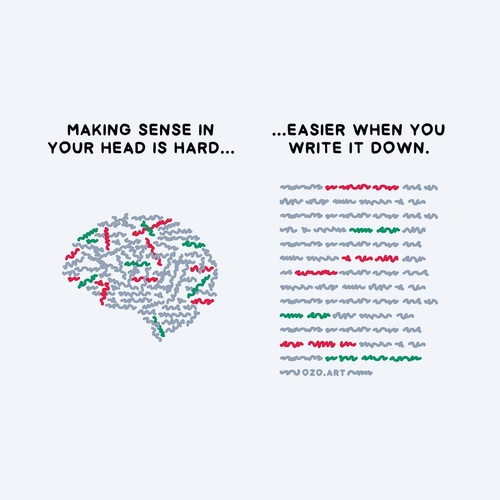
Making Sense… Easier.

I made a very deliberate choice to publish these daily writings with no images.

It streamlines the process and challenges me to make my words the art.

But sometimes, you come across an image that’s so good, you start to question whether there is any possible way to explain the idea better with only words…

And the below image (link here if it’s not showing) felt like one of those ideas:

The power of writing things down. By Janis Ozolins / ozo.art

…This is what this daily writing practice is about.

…This is what having some kind of reflective / therapeutic practice is all about.

…This is what inner work is about.

It’s about taking everything that’s floating around nonsensically and non-linearly in our head—out of our head—and laying it all flat on paper, canvas, or screen… and making sense of it all and giving it some kind of linear understanding.

The people who don’t make time for reflective type inner work… experience a harder type of existence. Not because their existence is inherently harder… but because they haven’t done the smart work required to make it easier.

…Yet.


P.s. ICYMI you can read the best of what I posted to MoveMe Quotes last week here.

What Do You Think?

To be thoughtful, you have to give yourself space to think.

…And not just think your way through a hectic day.

I mean, space to actually think… space to let your mind filter and sift… space to let your subconscious mind chime in… space where you can finally stop the barrage of incoming stimuli and can take a look at what’s already within.

Without a space like this, it’s incredibly hard to be thoughtful… to think more than one step ahead… to zoom out from the microscope of the day and look at your life trajectories in a more strategic way… to process all of the bite sized information and form authentic opinions.

And to be thoughtful in a world filled with people who are “too busy” to think… or maybe “too busy” to figure out how to make space to think… or maybe too brainwashed or addicted to even recognize they don’t have time to genuinely think…

…Is precisely what I think, we need.

Driving Forward Your Life

When driving, how much time do you spend looking in the rear view mirror?

…Maybe 1% of the time?

And how much time do you spend planning out your route in advance?

…Again, maybe 1% of the time it takes you to complete the actual drive?

I think these are good proportions to apply to driving forward your life as well.

I don’t think there’s ever a time we drive our car without looking in the rear view mirror or planning out our route in advance in some respect.

Just as I don’t think there should ever be a day when we drive forward our life without looking at our past or planning out our future route in some respect.

Of the 16 hours you spend awake driving your life forward (assuming eight hours of sleep), this means ~ 10 minutes each day should be spent reviewing the past and 10 minutes should be spent planning out the future (16 hours x 60 minutes = 960 total awake minutes x .01 = 9.6 minutes).

If you can remember to spent even just 5 minutes per day looking back and 5 minutes per day looking forward, I’d say your journey forward will remarkably improve.

…Probably in at least as much as the introduction of the rear view mirror and GPS remarkably improved driving cars.

Imagine that…


P.s. Need help planning out your life’s route? My guide (now 30% off) can help. Details here.