Skip to content

Category: Living Well

My Reading Comprehension Process

First, I make a small checkmark next to passages that resonate. This is the only kind of marking I use while reading.

Then, when finished, I re-read all of the checked passages and upload the best ones to MoveMe Quotes—my quote website that houses all of the best things I’ve read since October of 2010.

Finally, once I finish uploading all of the checked passages from the book, I create a list that presents all of them in both a coherent and personalized way. While making the lists, the first unique thing I do is organize quotes based on how they read—not based on page number. I try to present the ideas in a way that flows as one is read to the next… as though the quotes were being read as a book summary in their own right. Then, I add my own thoughts to the collection. I’ll write an introduction, provide necessary context, and connect resources at the end. Once it’s finished, I’ll snap a picture of me holding the book in front of my bookshelf and publish it for all to see—for free.

Why do all of this?

Sure it feels good to be the creator of a helpful resource. But, even more so, because it feels good to understand—to more deeply understand—the things I’ve read. And for each step that’s taken beyond reading, an invaluable layer of comprehension is added.

If you want to really get the full juice out of each book you read, one squeeze (from one read) isn’t enough. It’s the re-squeeze, the re-grip and re-squeeze again, capped off with a double-handed squeeze that makes the real difference.

Make The Means Your End

Most people get handed a picture of the mega-rich lifestyle and say, “Yup, that’s what I want” and spend all of their time and energy trying to paint a replica of that picture into their life without any further thought.

…Without any image at all of what their daily experience to achieve that end might look like, without any conversation around priorities, and without any authentic customizations or added personality to the picture. Just a singularly focused attempt to copy and paste another person’s end into their life, irrespective of the means.

But, what we must understand is that the means are the *real* end.

Meaning, how the moments are spent inside the lifestyle will always matter more than the mere end picture of the lifestyle.

My advice? Forget the picture. Focus on pin-pointing how you most want to spend your time. Ask yourself this fundamentally important question: “What does my ideal day look like?”—and reverse engineer from there.

Investing all of your available time and energy into an end without carefully considering the means is a mistake. Make the means your end and allow the masterpiece of your life to paint itself. Not based on some mega-rich person’s painting, but based on the brushstrokes taken uniquely by you, for you—starting today.


Inner work prompt: What does your ideal average day / lifestyle look like?

Living Easier

Writing every day is hard.

Not knowing what I think and living without clarity is hard.

One of them leads to far more difficulty and challenge than the other.

There is no easy-only option… only hard now and compounded hard later.

Understanding this is what fuels me to keep filling up these blank pages with words.

And understanding this might fuel you to reconsider some of the hard now options in your life, too.


P.s. Here are some of the other reasons why I write every day (and have for 1,200+ days).

The Best Way To Stop Is To Go

Loud noises scare my dog.

And when she’s scared, she’ll press into me insistently until she’s cradled and reassured that all is okay.

Leave her un-craddled and it’ll only get progressively worse. Don’t cradle her enough and she’ll persist and press into you until it is enough.

Telling her to stop being scared or pushing her away only exacerbates it.

However, give her a bone with some peanut butter on it? Or take her for a walk that’s filled with stimulating scents and smells? And she’ll forget what she was even scared about because she’s too preoccupied on the new experience / thought process.

…Assuming, of course, that it’s not a persistent loud noise or one that really shook her.

The takeaway here is an important one. Tell your mind or the mind of another to stop thinking or doing a thing—and it can’t help but continue thinking or doing the thing. Give the mind something else to focus on, however—something that’s captivating enough to consume a majority of its available mental resources—and you can’t help but stop thinking about / doing the other thing.

The next time you find yourself having negative self-talk, trouble with self-control, trying to help somebody who’s stuck thinking cyclically about something they no longer want to, etc—use this strategy of going to get them (or you) to stop.

Wall Mounted Squeeze Bottles

I’m in Disney this weekend at a Martial Arts Business Conference & World Class Tournament.

One of my young team members is here for the first time with me, not only competing at the highest level, but soaking in the whole Disney experience.

I asked him yesterday what his impressions were.

…He didn’t need to think about it.

He quickly started describing to me the most amazing thing he had seen that was right in his hotel room—the shower to be exact—and told me about these different wall-mounted squeeze bottles that each contained different liquids… one that had a thick, green shampoo gel… one that had a more white, runny conditioner (and how he didn’t really know what the conditioner was for)… and finished by telling me about the body wash and how it was more of a smooth blue gel.

…And he was absolutely floored by this.

Which made me see it in a brand new light myself—and is why today, I’m thankful for these everyday products that I otherwise would’ve never even given a second thought to; the products that keep me feeling so fresh and so clean; the products that I would have zero idea how to make if I was lost in the wilderness and had to live off the land.

Drive To Play

Tonight, for the first time in a long time I got to play sand volleyball with some friends.

It was the type of game where none of us were keeping score, all of us were yelling, diving, and cheering, and we all were about as bad as the rest—and it was a blast.

Towards the end of the game, I noticed an older women in uniform, presumably a facilities worker, who was watching curiously from the sideline.

It’s hard to describe, but in the manner of her body language, tilt of her head, and look on her face—it was as though she was living vicariously through us for that brief blip of time—unlike the other spectators who were very casually watching.

It was as though she was entranced—maybe remembering times from the past? Maybe soaking in some of the fun for herself? Maybe just entertained by the ridiculous sight of it all?

…What she was thinking, I’ll never know.

But, what it got me thinking about was how grateful I was to be the participant in those moments. To be the one on the court doing the yelling, diving, and cheering. To be the person in that privileged position of being able to play the game.

Something I think many of us take for granted… until one day we find ourselves drawn to a commotion… that’s on our path home… that contains this scene of people yelling, diving, and cheering… that leads us to a sideline… where we find ourselves watching vicariously…

And suddenly… without a drive to play.

Harder Than Ever

My running buddy and I decided to take a break from our early morning run this week.

The extra sleep, we voted, was the more valuable priority.

I got a text not long after that said “Back at it next week, harder than ever.”

This, in my estimation, is a very common response in our hustle, grind, crush it culture.

We take a (much needed) break and then feel guilty because we’re “supposed” to always be on and hustling and grinding, and crushing it… so we double down on the comeback workout and vow to go “harder than ever…”

But, there’s nothing to feel guilty about.

If a genuine break was needed and a higher priority task was put in its place, this is strategy—not something that should make us feel guilty. This is how we play the long-term game, rather than appeal to the short sprints that make us resent the practice altogether.

I replied and said, “No need to make it harder—just back at it. No need to owe yourself anything. No need to beat yourself up. We listen to our bodies and show up with what we have when we’re able.”

And as long as we’re clear on our priorities and honest about what we’re telling ourselves when we miss—this is the path.

Killing ourselves is an awful strategy for long-term success.


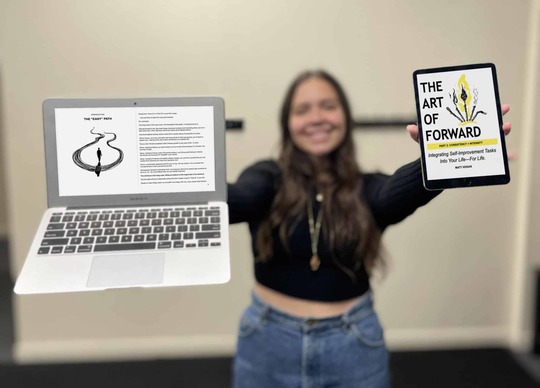
P.s. This is the LAST week to get The Art of Forward (Direction > Speed) at 52% off! After this week, the coupon code (LAUNCH) will expire and the price will return to normal.