Skip to content

Category: Living Well

Thank You

Hi Matt,

I just wanted to write and thank you so much for all your work pulling all these quotes together. I am a fellow quote collector and have mountains of notebooks filled with them, with no sense of order at all. Your website is a treasure trove, and I really appreciate the labour of love it must have been (and still is).

Many Thanks,

Sonya

Sent from my iPhone

The reason I wanted to share this email that I received this morning is two-fold:

1) It’s a beautiful example of expressed gratitude. Something I challenged the readers of this blog to integrate into their lives during the month of November. It’s pure, it’s short, there’s no ask or expected favors in return, and it was sent evidently on a whim—as is indicated by the “Sent from my iPhone” stamp which was included at the bottom of the email (which is why I included it above). If you haven’t started the challenge yet or are just hearing about this now, consider this your invitation. Because…

2) It’s a beautiful example of the rippling effect expressed gratitude can have. This email made my morning. It brought a big smile to my face, made me feel pride towards the work I’ve done building MoveMe Quotes, and inspired this very post that’s being sent out to hundreds of readers—something that never would’ve happened without the expressed part of the gratitude. And now, maybe some of you will go out on a whim and send an email / text / or note to someone you want to thank in your life.

I hope you will.
Questions To Snap You Back To Happiness

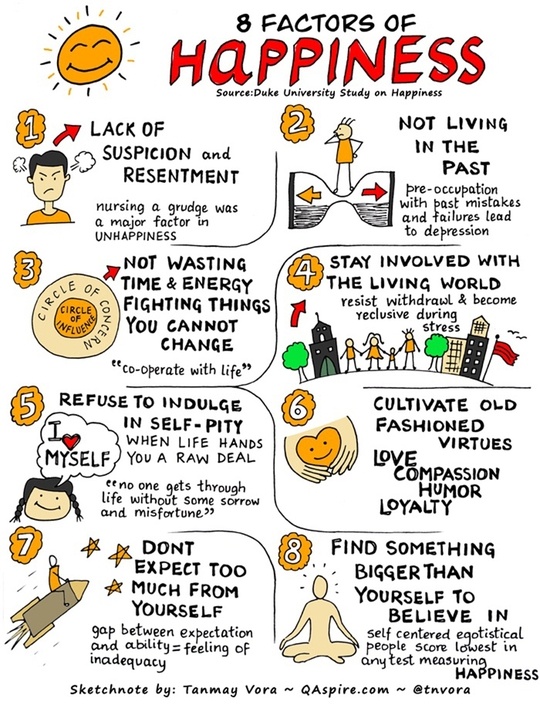
The following was inspired by Claudia Dawson and a Duke University study on Happiness via Recommendo.

First, here’s the Duke University study findings:

(Click here if you can’t see the above infographic).

Next, here’s what Claudia Dawson so brilliantly recommended based on these findings…

“I’ve found the quickest way to dispel unhappiness is to ask myself introspective questions to find the source. Based on these 8 factors of happiness, I would ask myself: 

  • Am I feeling suspicion and resentment? 
  • Am I living in the past (or in the future)? 
  • Am I wasting time and energy fighting conditions I can’t change? 
  • Am I isolating myself or withdrawing from the world? 
  • Am I indulging in self-pity?
  • Am I expecting too much of myself? 

…I then continue the line of questioning to gain more self-awareness or I pivot to an easy gratitude practice, like listing 10 things that make me happy on my fingers. This usually gets me out of my head and back to the present moment, as well as in alignment with the values and experiences that make me happy.”

Finally, here’s my take:

The thing about thinking is that so much of it is done unconsciously (like 99%?). As in, we have no idea that we’re bathing in self-pity, replaying the past, cancelling plans so we can introvert,” comparing ourselves to the greats, nurturing suspicion, etc…

Don’t take the above insights or questions lightly—this is life-changing stuff. Print / write it all down and display it in a place where you’ll see it regularly.

This way, it’ll snap you out of undesirable (unconscious) thought patterns and back to the place where happiness is much more likely to be found.

The 30 Day Expressed Gratitude Challenge

Join me in, not just thinking gratitude, but expressing gratitude every day for the next 30 days.

The difference is that one leaves your mind about as quickly as it enters whereas the other—the expressed gratitude—makes an impression on the mind of another (that’s remembered), creates an atmosphere that’s felt, has the potential to linger (as a smile often does), and can resultantly ripple outward to touch countless other lives, too.

And the kicker is that the gratitude given to another affects the giver as much as the receiver—it’s a double positive.

There is nothing lost and everything is gained when the gift of gratitude is given away.

That said, here’s how the challenge works:

  • Either share publicly (on a social site) or record privately your daily acts of gratitude.
  • It must be expressed—not just thought of.
  • Expressed could be shared verbally (e.g. “I just want to sincerely thank you for…”), written physically (e.g. A surprise post-it note), posted about socially (e.g. “Today, I’m grateful for ______. Join me for 30 days of expressed gratitude.”) , or even gifted tangibly (e.g. Flowers just because).
  • The more specific the better. The more detailed the better. The more thoughtful the better.
  • …But, “done” is the best. Don’t let “the perfect gesture” stop you from expressing at all.

And that’s it. Who’s in?! Forward this to whoever you think would join. Let’s flood our lives with positivity, warmth, and support for the next month. Lord knows we all could use it.


I’ll record my acts here. Day 1: Today, I texted a coworker expressing my gratitude for an above and beyond effort that they did with grace. :)

How To Get A 200%+ Return On Investment With Your Time

I went to bed early last night.

About an hour earlier than usual.

And what never ceases to amaze me is how much more productive I feel, how much better my self-control is, and how much clearer my mindset presents—all from just a one hour investment.

Which is exactly what we should be looking at going to bed earlier as.

As discussed in yesterday’s piece, more awake hours ≠ more productivity / more joy / more living—per se. It’s more quality hours (not quantity) that leads to that.

And what I’m noticing in my own life, today particularly, is that the move from 7 hours of sleep to 8 hours causes more good in awareness, clarity, and productivity than the move from 8 hours of sleep to 7 hours causes good in extending length to “do more stuff.

In other words, let’s say an hour less of sleep causes a 12.5% dip in general functionality across the board (if eight hours = 100% recharge, then one hour = 12.5% of that recharge).

That 12.5% dip then affects the rest of my 17 hours in the day that I’m awake.

And a 12.5% reduction (in awareness, clarity, and productivity) over 17 hours amounts to 2.125 hours in total lost time (17 x .125 = 2.125 hours)!

So, how do you get a 200%+ return on investment with your time…?

Go to bed an hour earlier.


P.s. I also published: A Wise Woman’s Advice To A Young Man Whose Life Was “Full Of Pain” [Excerpt]

The Formula Forward

We align ourselves with what serves us first, so we can best serve those who we most align with second.

This is the formula forward.

Many people try to reverse this formula and align themselves with what best serves others first and then only serve themselves with whatever time/energy is left over and after the fact.

The reason this strategy doesn’t work (maybe less optimally… maybe not at all) is because serving others is an infinite and endless loop.

You could very well give every ounce of time and energy you have to the people closest to you and still be met with this black hole of insatiable needs and desires.

Not only is this incredibly exhausting and demoralizing… but debilitating.

We must remember: so long as we’re willing to give time and energy, so too will others be willing to take.

Think about it. Time and energy are our life’s most precious resources. And whenever another person gives us some of theirs, not only is it an invaluable investment but an affirmation of worth of ours.

And while this sounds like a wonderful gift to give to those closest to us, it completely disregards the person who’s closest…

Yourself.

If you aren’t willing to invest any of your most precious resources into yourself, how can you expect your ability to serve to grow? This is no different than an investment account.

No continued investments? No continued growth. Plain and simple.

And the time to invest isn’t after all of your money has been spent. It’s first and foremost—automatically preferably—so that your growth is guaranteed irrespective of the “market conditions” of those whom you’re most aligned to serve.

Life’s Memory Thief

Want to get some of your favorite life memories stolen?

…Give in to inertia.

Let the feeling of being stuck… keep you stuck… and withheld from experiencing the world in the way you originally planned… hoped to… dreamed you would…

Inertia is the ultimate memory thief.

It creeps up on you, slowly weighs you down, and sabotages plans.

Unless you stop it.

Or should I say… keep things moving to avoid coming to that crippling stop altogether.

Break inertia by taking that initial step as soon as you can… by sticking to your plan(s)… by giving yourself the kick in the ass you’d wish you’d gotten when you gave into inertia before and missed out on something grand that you wish you hadn’t.

And keep that momentum moving forward—however slowly—in the right direction…

…The direction of what could undoubtedly amount to be, your life’s favorite memories.


P.s. I also published: Letting Your Bow Relax—A Short Story About Not Being So Serious All Of The Time

Take Care Of Your Room(s)

I’ve been trying this new strategy where, every Sunday, I set aside a few hours to deep clean/revamp one specific room.

This week it was my work room.

Not only did I declutter my desk, throw away a ton of crap, rearrange the furniture/decor, and give everything a good wipe down… but, I also bought and installed this clean, 5-tier floating corner bookshelf.

Why? Because I like the way it looks plus it’ll give me more room to organize the crap I don’t want to throw away.

And here’s the thing… liking the way things look and feel in your environment improves the way you feel and look at things while in it.

The degree to which this is true varies person to person. Some people seem to be strongly affected by the environment’s look and feel and some seem to carry on irrespective of it.

But, in my observation, seemingly unaffected doesn’t mean unaffected.

In my own life, I’ll occasionally recognize a psychological weight that’s being held by a task I’m leaving undone. One I keep putting off, that I know I’m putting off, that requires a little more time than I usually have, which is the excuse I always use, that results in this drag that, when I notice it, definitely affects the way I feel.

And then there are times when I walk into a room—like my work room after my work on it—and instantly notice a lightness… an excitement… a sense of relief… which, I know continues even after I’ve become used to the changes.

This is all to say: take care of your environment and your environment will take care of you.