Skip to content

Category: Archives

The full collection of explorations.

Write Your Own Damn Script

Something amazing I saw on social:

“Sung Kang’s character, Han Lue, in the Fast and Furious franchise, is often seen snacking, and this is directly related to Han’s history as a smoker. In the original indie film Better Luck Tomorrow, where the character originated, Han was a chain smoker. Sung Kang decided to replace smoking with snacking in the Fast and Furious movies, as he felt it was important to not portray smoking as a cool habit to young audiences.”

I can tell you first hand, after watching Peaky Blinders and being completely captivated (borderline obsessed) with Cillian Murphy’s character Tommy Shelby—smoking seemed like an interconnected part of the character that would be hard to manifest without the cigarettes (fun fact: Cillian Murphy was never actually smoking cigarettes in any of the episodes—they were herbal cigarettes made without tobacco or nicotine).

And hearing the intentionality behind Sung Kang’s decision to take smoking out of the picture altogether was such a refreshing story to hear. Sometimes, I think we forget about the power we have over our own decisions and ultimately, our destiny. Just because others have portrayed something in a certain way (smoking = cool), doesn’t mean we have to. And just because somebody had something written in a script (doctor = only successful path), doesn’t mean we have to follow it verbatim.

You can alter your script. You can change the direction of your script. Heck, you can even write your own damn script from scratch. But, it all starts with intentionality. And intentionality comes from inner work. Without it, you’ll never know any better than to copy/paste what everybody else is doing and telling you to do…
No Turn On Red

If you have to turn right on red at a light where you’re not allowed to turn right on red… and you know that but you choose to risk it anyway… You’re too busy.

…And not even in schedule. I’m talking about in mind.


P.s. Yesterday I sent out the final post (for now) of my Bosnia reflection series. You can read all 12 reflections here.

Jumping From Bridges For Money

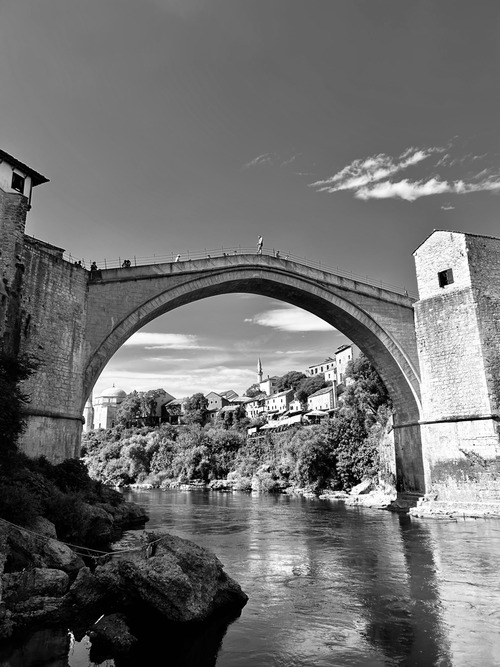
That’s right… there’s a guy at the highest point of this bridge (in Mostar, Bosnia), standing over the guard rail, with one foot hanging over the side. [Image link if not shown above.]

And yes… there are people walking casually past him.

This is apparently a regular occurrence. A tourist attraction of sorts, where, once the guy collects enough money, he will jump into the water some 67 feet below.

But, after speaking to a born and raised Bosnian who knew a lot about the young men of that age… it runs deeper than just being a cash-grab or adrenaline seeking sport…

A lot of the young men in the region grew up in a war torn world. A world that was devastated with ruin. A world where thousands were brutally killed—many of whom where members of these young men’s families.

And yes, the Bosnian war ended when they were relatively young… but, their world certainly didn’t just go back to normal after that. For many of these young men, there were no schools… there was no family support… there was no community structure at all.

And because of all this… and the unimaginable amount of grief and challenge… they do today all they know how: bartending… boat tours… and yes, jumping from bridges.

A lot of times you’ll hear people in modern society complain about the job market or fuss over trivial matters in relation to their job. But, can you imagine living in a world where all you have is a third grade education? …Maybe there is more opportunity for us than we might be giving ourselves credit for.

History Should Lead To A Better Future—Not Worse One

On the last day of my trip to Bosnia, I ate at a dessert café.

The waitress was one of the nicest, funniest, most outgoing people I met the entire trip.

And because of the nature of Bosnian cafés and how long one can spend relaxing and enjoying… and because of her nature of being somewhat of a “blabber-mouth” (her words, not mine)—I got to hear some of her story.

She was going to university for marketing… was working as a waitress to cover her living expenses… lived at home with her parents, but prided herself in only buying and earning what she could afford.

“I’m a strong, independent women” she said at one point as she flexed her arm and giggled.

Towards the end of our intermittent exchanges, as we talked about travel and life goals, she mentioned that her and her family had applied for visas to travel to the U.S… and all of them got approved except for her… the only difference being she wore a hijab and they didn’t.


Worth mentioning here, too, is that Adis—the gentlemen who gave me that 9-hour tour of Mostar—said he was friends even with those who his parents were at war with.

He said he was only three when the war was happening and so were the people he was associating with. They weren’t at war with each other and so why act like they were today?

He made a brilliant comment that his history was meant to serve as a reminder, as a lesson, to lead to a better future… not a repeated, more discriminatory, worse one.

I Hiked The 1984 Olympic Luge Track

One of the highlights of my trip to Bosnia was a hike that allowed you to walk inside the bobsleigh and luge track that’s situated on Trebević mountain overlooking the City of Sarajevo, built for the 1984 Winter Olympics.

The track was about a mile long, had about a 10% grade incline, and 13 turns. It cost about $8,500,000 USD (563,209,000 YUD) to construct in 1981 and took a little over one year to complete. It’s still mostly in tact today, even after the Yugoslav and Bosnian Wars, and has become an incredible relic and spectacle for modern day explorers.

Today, it’s filled with overgrowth and graffiti and provides a fascinating backdrop for hikers that contrasts beautiful green natural scenery with massive concrete track slabs that are filled with colorful and vibrantly sprayed artistic expressions and images.

As I was walking down the massive track, feeling the quality of the concrete under my feet, imagining the effort that went into the track’s development, visualizing the incredible experience thousands of people had as a result of its realization… I couldn’t help but wonder, what else could we have created by now if we didn’t spend so much time, energy, effort, and money trying to destroy, conquer, and steal…

The Most Beautiful Of Charitable Acts

“The most beautiful of charitable acts are the ones that constantly renew themselves.”

Let me tell you a little bit about Ghazi Husrev-Beg.

He earned the title of ghazi or hero, which was given to outstanding Turkish soldiers/heroes for their military success and bravery. He arrived in Bosnia around 1521 and became governor. And—most importantly for this post—he later bequeathed his property and wealth and contributed the following to the city of Sarajevo, the capital of Bosnia and Herzegovina:

  • A magnificent mosque.
  • A humanitarian public kitchen (imaret).
  • A unique and exceptional school (madrasa)—where, in addition to religion, one could freely discuss philosophy, poetry, and ethics.
  • A famous library, which houses one of the richest collections of Near Eastern writings.
  • A hastahana (park) as a hospital.
  • A water supply system that brought in water from a spring seven kilometers from Sarajejevo, channelling it into 40 public fountains (including a šadrvan)—which was one of the first water supply systems in Europe at that time.
  • A Hamam for bathing and sweating, spaces for keeping up fire and heating of water, and floor heating by using warm air.
  • A great meeting place of the rich merchant caravans (Sarajevo Tashlihan).
  • A roofed over market that housed the widest variety of textiles.
  • Numerous shops in which hundreds of skilled hands forged, sewed, did embroidery and traded.

All this in around a 20 year period between 1521 and when he died in 1541. These contributions continue to renew themselves and serve Bosnians to this day.

…It makes you wonder: what contributions might we (you) offer that have a renewing capability and can extend long after we pass, too?

Meet Safa

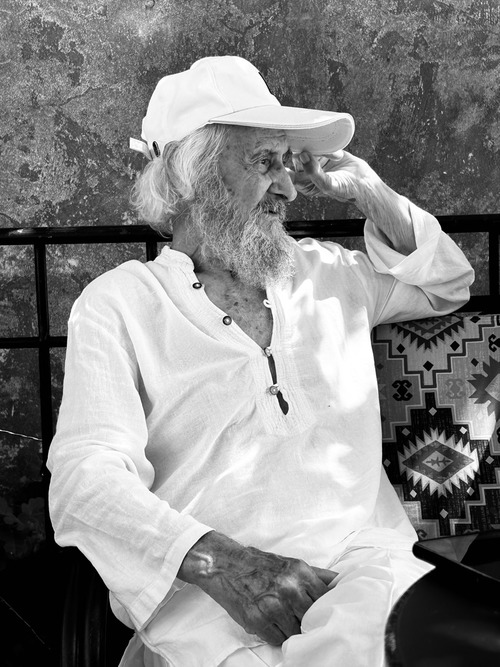
Safa is 84 years old. He’s a born and raised Bosnian. He worked as a copper artist—hammering and contorting the metal from his own store in Mostar—for 30+ years. He’s incredibly light on his feet—jumping up from seated positions, skipping while walking, and spontaneously dancing when his spirit calls for him to. And is the living embodiment of ćejf.

I got to spend an entire day with him, sipping coffee and 0% beer for hours at a time, touring through some of his favorite local restaurants and artisan shops, and hearing stories from his life.

Of everything we discussed, here are three highlights I thought were worth sharing:

1. I asked: Do you exercise? He said (and I’m paraphrasing here): Never (formally) a day in his life. He always just worked hard—hammering away in his copper shop. And he was always trying new things physically—like “L-Sits,” “Planche Holds,” one arm pull-ups, hanging from a bridge with one hand, or even high jumping from bridges into the water below. He said the more he successfully did things physically, the more confident he became with himself and the more he continued to try. One of his favorite things to do was “bust jacked people’s egos” by one-upping them. And he said the other aspect that really helped with his physicality was that he always spent a lot of time with women (lol).

2. I asked: What are some of your favorite memories? He said the time he spent with his wife.

3. I asked: What are some of his regrets? He said not being able to build the family he wanted and help raise his son.