Skip to content

Month: July 2025

The Most Beautiful Of Charitable Acts

“The most beautiful of charitable acts are the ones that constantly renew themselves.”

Let me tell you a little bit about Ghazi Husrev-Beg.

He earned the title of ghazi or hero, which was given to outstanding Turkish soldiers/heroes for their military success and bravery. He arrived in Bosnia around 1521 and became governor. And—most importantly for this post—he later bequeathed his property and wealth and contributed the following to the city of Sarajevo, the capital of Bosnia and Herzegovina:

  • A magnificent mosque.
  • A humanitarian public kitchen (imaret).
  • A unique and exceptional school (madrasa)—where, in addition to religion, one could freely discuss philosophy, poetry, and ethics.
  • A famous library, which houses one of the richest collections of Near Eastern writings.
  • A hastahana (park) as a hospital.
  • A water supply system that brought in water from a spring seven kilometers from Sarajejevo, channelling it into 40 public fountains (including a šadrvan)—which was one of the first water supply systems in Europe at that time.
  • A Hamam for bathing and sweating, spaces for keeping up fire and heating of water, and floor heating by using warm air.
  • A great meeting place of the rich merchant caravans (Sarajevo Tashlihan).
  • A roofed over market that housed the widest variety of textiles.
  • Numerous shops in which hundreds of skilled hands forged, sewed, did embroidery and traded.

All this in around a 20 year period between 1521 and when he died in 1541. These contributions continue to renew themselves and serve Bosnians to this day.

…It makes you wonder: what contributions might we (you) offer that have a renewing capability and can extend long after we pass, too?
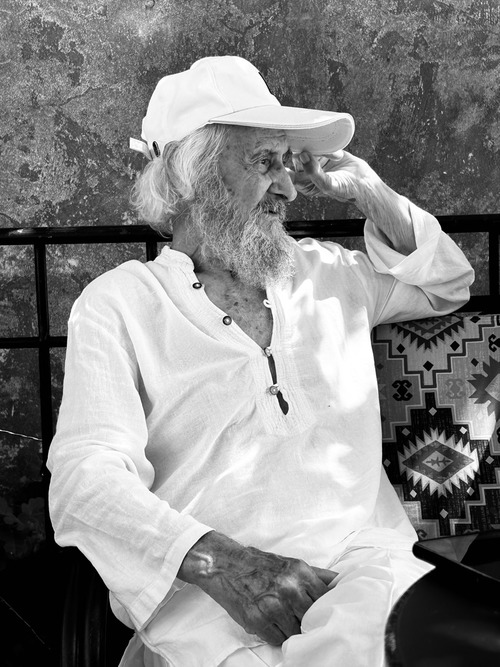
Meet Safa

Safa is 84 years old. He’s a born and raised Bosnian. He worked as a copper artist—hammering and contorting the metal from his own store in Mostar—for 30+ years. He’s incredibly light on his feet—jumping up from seated positions, skipping while walking, and spontaneously dancing when his spirit calls for him to. And is the living embodiment of ćejf.

I got to spend an entire day with him, sipping coffee and 0% beer for hours at a time, touring through some of his favorite local restaurants and artisan shops, and hearing stories from his life.

Of everything we discussed, here are three highlights I thought were worth sharing:

1. I asked: Do you exercise? He said (and I’m paraphrasing here): Never (formally) a day in his life. He always just worked hard—hammering away in his copper shop. And he was always trying new things physically—like “L-Sits,” “Planche Holds,” one arm pull-ups, hanging from a bridge with one hand, or even high jumping from bridges into the water below. He said the more he successfully did things physically, the more confident he became with himself and the more he continued to try. One of his favorite things to do was “bust jacked people’s egos” by one-upping them. And he said the other aspect that really helped with his physicality was that he always spent a lot of time with women (lol).

2. I asked: What are some of your favorite memories? He said the time he spent with his wife.

3. I asked: What are some of his regrets? He said not being able to build the family he wanted and help raise his son.

Ćejf

Pronounced /chey-if/: not just a Bosnian word but a way of life. It’s a slow and silent enjoyment of something or someone; it’s a deep satisfaction or contentment; it’s what I wrote yesterday about coffee culture.

And it’s not just coffee that we might be doing wrong… maybe it’s food too? I did not see a single drive thru restaurant my entire time here in Bosnia. Not one. Because here, drinking coffee and/or eating “to-go” is almost blasphemous.

Coffee/food is something meant to be consumed slowly… something to be shared generously… something that’s supposed to elicit a deep contentment in-and-of the act itself.

The idea with ćejf is the same idea that many of us daydream about as we kill ourselves working 9-5 jobs. We imagine ourselves sitting on a beach, by the turquoise water, sipping on a margarita—experiencing ćejf.

Or even more simply, getting home after a long day, kicking off our shoes, loosening up our tight clothes, and finally sitting in our most comfortable chairs next to loved ones—to experience ćejf.

The problem is that too many of us are far too busy to experience ćejf.

…We wake up and we’re already late for work. We rush to work, but only want to be back home. Exhausted, we pick escapes and quick dopamine hits via screens and ignore everything and everyone around us in reality throughout.

Ćejf is not something that can be rushed.

…Just like anything of quality can’t be rushed.

And if you’re the type who is always rushing… it might be worth thinking about whether there’s enough space and time in your day/life for ćejf to slowly… silently… gracefully… seep its way in.

Are We Doing Coffee Wrong?

Coffee in Bosnia hits different.

Coffee isn’t bought in drive thrus and chugged on the go… it’s sipped slowly in cafés scattered throughout the city (like this incredible one in Mostar).

It isn’t something that’s used solely for caffeine intake, it’s used as a means for conversation and connection (I sat at the above linked café maybe five times… and each was for an average of two hours).

It isn’t even used as a means to maximize profit… once you sit and place your order, the waiter/waitress won’t come back to you until you waive them down or get up to leave. 

There’s zero pressure… zero interruption… and zero care for how long you stay and sip, chat, and relax (like, literally, I couldn’t conveniently order more drinks even when I wanted to).

It’s a major cultural shift from what I’m used to America. But what is a cultural shift except a change in attitude that catches on?

…Maybe slowing down and learning to use coffee as a means as opposed to an end is a vibe you think is worth catching onto?

When Hit With Stone… Hit Back With… Bread?

A local born and raised Bosnian was telling me that a common Bosnian mentality is: When hit with stone, hit back with bread.

The idea being similar to the one Mahatma Gandhi is commonly attributed to saying: An eye for an eye makes the whole world blind.

But what this local Bosnian continued with was: “…But don’t let forgiveness and kindness lead to naiveté and vulnerability.”

Because the man who goes around making people blind, without any remorse, care, or heed needs to be confronted, challenged, and held accountable.

Bosnia is an unbelievably beautiful place. And since I’ve arrived, every single Bosnian I’ve met has hit me with bread. And more bread. And even after I was full—more bread after that. The hospitality is unmatched.

One thing you’ll notice about the city, however, is that there are still architectural “scars” scattered throughout from a time when they were hit with stone… and then barraged with stone during the Bosnian War.

…Abandoned buildings with bullet holes standing next to fully renovated apartments. Modern restaurants sitting under structures that have massive holes from bombings. Once beautifully designed, impressive feats of architectural ingenuity and creativity, stand ruined… behind vine-filled fences… right in the heart of the city.

Why are they still there and not torn down, fully renovated, or at least patched up so as not to be on display for all to see?

I can’t know all the factors, but at the very least I suspect they’re there because scars are meant to serve as reminders.

…That maybe when someone hits you with stone, you do your due diligence before you hit them back with bread.

Put A Small Rock In Your Shoe

“When things are going well, put a small rock in your shoe.”

This is what the mother of Adis—the guy who guided the 9-hour tour I was on yesterday—tells him when everything in his life is going well.

His parents lived through war. They’ve experienced unfathomable evils. And to top it off, they’ve had to build everything in their life from scratch—their house, their farm, their sense of any kind of stability—not once, but multiple times.

…Can you imagine? Literally building your life brick-by-brick, plant-by-plant, sweat droplet-by-sweat droplet, only to have it completely destroyed… and then doing it all over again?!

What I think his mom is reminding him is don’t rely solely on luck in life.

…Because what Adis’ parents went through and what he’s going through is merely a difference in uncontrollable worldly luck.

But when you keep a small rock in your shoe, you remember not to take luck for granted.

…And you learn how to roll up your sleeves and do hard work; you learn how to accept painful situations and confront reality with what’s in your control versus burying your head in the sand (read: screens); you learn how to be damn grateful for the luck when it is there—because if there’s nothing else history has taught us it’s that luck is never promised.

…And having that small rock in your shoe will have you more ready for the un-luck than comfy-cozy shoe living ever will.

Keeping Death Out Of Sight, Out Of Mind

In all Bosnian cities, they place cemeteries in the city centers—in the prime real estate locations—so as to remember those who have come before… and to serve as a reminder of where we’re all heading.

Contrast this with most other cities in the world… and what will you find at the city centers?

And maybe more importantly to consider… where are the places for those who have passed in those cities? What about the places where those who are about to pass go? Where do we (you) ever stumble across death in our lives (besides the news where we’re desensitized to all things violence and death)?

…Keeping death out of sight, out of mind doesn’t help with life.

In fact, I’m of the opinion that it makes us forget where we’re all undeniably heading. And when you forget where you’re heading, you forget to make the most of the trip along the way.