Skip to content

Category: Making A Difference

Turning Good States Into Good Karma

When you’re feeling strong, remember what it was like to feel weak. For using your strength to help the weak is one of the best uses of strength.

When you’re feeling calm, remember what it was like to feel anxious. For using your calm to help the anxious is one of the best uses of calm.

When you’re feeling joyous, remember what it was like to feel upset. For using your joy to help the upset is one of the best uses of joy.

When you’re feeling outgoing, remember what it was like to feel lonely. For using initiative to help the lonely is one of the best uses of outgoing.

When you’re feeling fulfilled, remember what it was like to feel empty. For using fulfillment to pour into the empty is one of the best uses of fullness.

What I want you to read in the above statements is that we have all experienced all of the above. Not in permanent ways, but in fleeting ways. And so it will continue.

The best thing we can do within the fleeting moments of our days is (1) do things that have the best chance of resulting in the more desired states, (2) be mindful enough to recognize these states when they arrive, (3) be more deliberate in how we pay these desired states forward.

…Because it won’t be long until you find yourself in one of the lesser desired states once again. And intentionally circulating good karma is an excellent strategy for helping not only others… but your future self, too.
Half-Hearted Mixed With Resentment

One of my martial arts instructors asked me what my thoughts were on another instructor’s decreased presence because of an increased presence elsewhere and outside of the academy.

…He was concerned this instructor may choose to walk a different career path and very much wanted him to choose martial arts as his career path.

My response was simple… “Let him.”

I’ve worked with high performers my whole professional life and I know that high performers within the academy are most likely high performers elsewhere as well—and this is a beautiful thing.

The mentality should never be to stop them from exploring other areas of interest or guilt them into making martial arts the exclusive focus in their life.

The mentality should be to make our art and career so appealing and exciting that they choose us over the alternatives willingly and full-heartedly.

Because if they don’t choose us willingly, then they’re going to build up resentment. And half-hearted mixed with resentment is a bad formula for any kind of a long term partnership.

…And I’m not just talking about jobs.

“I Don’t Match The Energy, I Set The Standard.”

…Is a powerful mantra to help guide you through days filled with difficult, annoying, lethargic, frustrating, unjust type people (and more).

A coworker hit you with a bunch of negative energy? Hit them back with a bunch of the opposite. Don’t match their energy; set the standard.

Eating highly processed fast food a norm in your family? Lead by example and prepare wholesome, easy, nutrient dense meals. Don’t match their energy; set the standard.

Find yourself in a situation where something wrong is happening and everybody around you is a bystander? Stand up and speak out. Don’t match their energy; set the standard.

Did you hate the way somebody taught you (or tried to teach you) a lesson? Teach that lesson to somebody else in a way you would’ve loved to have learned it. Don’t match their energy; set the standard.

Hate how divisive news, media, and politics is making our society? Turn it all off and volunteer at a local nonprofit or soup kitchen—something that’ll connect you to other humans regardless of their background, beliefs, or political standing. Don’t match their energy; set the standard.

Now go ahead and write this on your bathroom mirror or save it as the background of your phone. And keep it at the forefront of your mind so you can help us not only set… but raise the standard.

A Lesson From My 90+ Year Old Neighbor

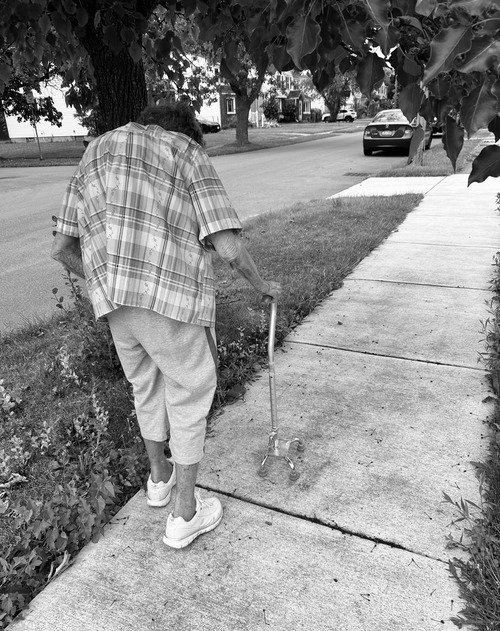
My neighbor

This is my neighbor (Image link if it doesn’t show above).

I don’t know how old she is, but my guess is well into her 90s. Her spine has her hunched over almost a full 90 degrees and she’s more blind and deaf than she is seeing and hearing.

Today, she ventured over to my house and we had a quick chat. A lot of what she was saying didn’t make sense, but, I carried on with her at a decibel loud enough for all of the immediate neighbors to hear. Once finished, she turned to leave and I followed her home.

…What I found interesting is right as she turned the corner from her driveway onto her front porch walkway, she noticed out of the corner of her downward pointed gaze a flower pot and a weed. She reached into the flower pot and pruned away the dead branches… took a few more steps, grabbed the weed that was as tall as her, bent it to the ground and stomped on it until it snapped.

…And yet, just a few moments earlier, when we were talking in my driveway, she told me that if she died, her house would go to her son and daughter—which, she said as casually as she did their names—”might be tonight.”

…And yet, there she was, still tending to her garden; still bringing beauty to the world; still managing what worldly chaos she could in the best way she knew how.

The Most Beautiful Of Charitable Acts

“The most beautiful of charitable acts are the ones that constantly renew themselves.”

Let me tell you a little bit about Ghazi Husrev-Beg.

He earned the title of ghazi or hero, which was given to outstanding Turkish soldiers/heroes for their military success and bravery. He arrived in Bosnia around 1521 and became governor. And—most importantly for this post—he later bequeathed his property and wealth and contributed the following to the city of Sarajevo, the capital of Bosnia and Herzegovina:

  • A magnificent mosque.
  • A humanitarian public kitchen (imaret).
  • A unique and exceptional school (madrasa)—where, in addition to religion, one could freely discuss philosophy, poetry, and ethics.
  • A famous library, which houses one of the richest collections of Near Eastern writings.
  • A hastahana (park) as a hospital.
  • A water supply system that brought in water from a spring seven kilometers from Sarajejevo, channelling it into 40 public fountains (including a šadrvan)—which was one of the first water supply systems in Europe at that time.
  • A Hamam for bathing and sweating, spaces for keeping up fire and heating of water, and floor heating by using warm air.
  • A great meeting place of the rich merchant caravans (Sarajevo Tashlihan).
  • A roofed over market that housed the widest variety of textiles.
  • Numerous shops in which hundreds of skilled hands forged, sewed, did embroidery and traded.

All this in around a 20 year period between 1521 and when he died in 1541. These contributions continue to renew themselves and serve Bosnians to this day.

…It makes you wonder: what contributions might we (you) offer that have a renewing capability and can extend long after we pass, too?

A 30 Second Tournament?

A friend was telling me about his son’s first Jiu-Jitsu tournament.

He went against a kid who was way better than him, got tapped three times in less than 10 seconds each, and that was it. Over and done.

Sure, a good coach can find plenty of coachable moments buried within that sub-30 second competition that could very well lead to hours and hours of pointed, high quality training.

But, as facilitators of experiences for kids, we should also be asking ourselves if this is the best we can do for our next generation?

Whether you’re a parent or not, a teacher or not, a coach or not… adults have an innate responsibility to pave a way forward for our next generation—in the same way the generation before did for us… and the one before them.

And what we should be asking ourselves is how can we maximize the experiential learning buried within each opportunity taken? How can we increase the reps, the time on stage, the effort required… so as to expand the amount of raw experience our kids can dissect (and learn) from? How can we make the IRL experiences as exciting and rewarding (and even as time consuming) as the damn video game experiences that are competing for their attention day-in and day-out?

As an adult reading this right now, I hope you’ll at least consider this question for the sake of the kids who could be impacted by the efforts and energy of your life…

What Makes Me Want To Give More…

When I see a student come in early and work on something I’ve taught or am curious about, I want to meet them there early and give more.

When I see a student stay late and get extra reps in on something from class or some above and beyond material, I want to stay after with them and give more.

When a students asks questions that extend beyond the scope of what’s required—that they can’t seem to figure out how to train past on their own—I want to answer those questions and give more.

When a student is struggling with curriculum and is persisting in the face of frustration, I want to step in and give more.

When a student gives more, I want to give more.

Which, isn’t to be confused with the student who constantly wants to take more.

When the student comes in early or stays late and wants me to teach them a private class… or asks questions about things they haven’t even tried to solve on their own… or wants answers to things they haven’t experienced frustration from yet… I feel like I’m being taken from as opposed to enthusiastically giving.

The difference is subtle… but, in its understanding is a powerful truth.

Invest the time, put in the effort, expend the energy yourself… and I will meet you on the other side.

Try and squeeze me for more time, effort, and energy without the match on your side… and I’ll eventually start taking away, too.